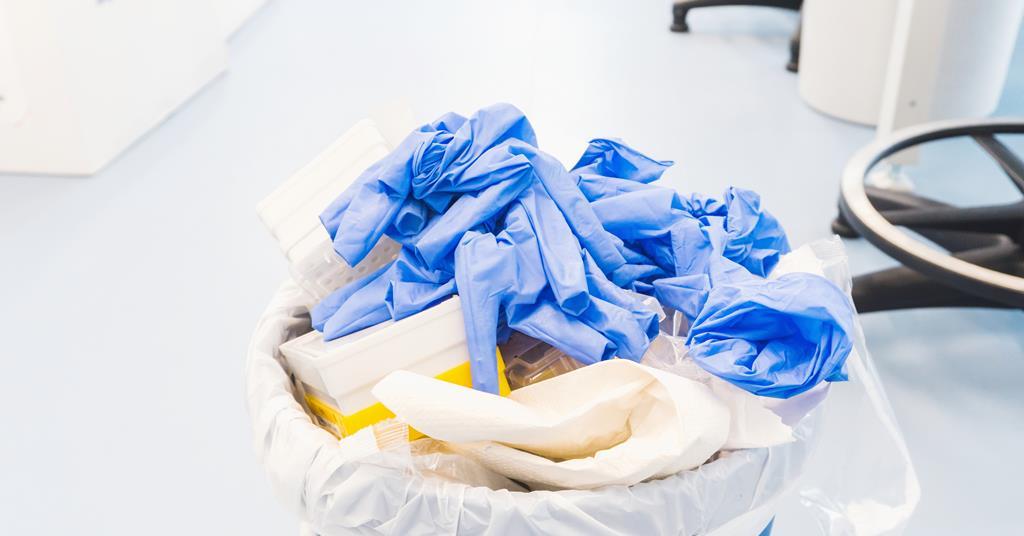
Remember those billions of nitrile gloves we all became familiar with during the pandemic? Most of them ended up in landfills, becoming part of a growing waste crisis. But what if we told you that your used medical gloves could help fight climate change?
Researchers from Denmark and the UK have independently discovered an elegant solution to this problem. Both teams have found a way to convert nitrile-butadiene rubber (NBR)—the material used in those ubiquitous disposable gloves—into functional carbon capture materials. The secret? A straightforward hydrogenation reaction that cleverly exploits the nitrogen functionality already present in the rubber.
**Why This Matters**
Nitrile rubber gloves represent a significant waste management challenge. Unlike some materials, they're notoriously difficult to recycle through conventional methods, making them prime candidates for landfills or incineration. With billions of gloves used globally every year—a number that skyrocketed during the COVID-19 pandemic—the environmental impact has become impossible to ignore.
Carbon capture technology, meanwhile, has emerged as a crucial tool in our fight against climate change. Materials that can effectively trap CO₂ from the atmosphere are increasingly valuable as we work toward net-zero emissions. The convergence of these two challenges presents a rare opportunity: take a waste product that's hard to dispose of and transform it into something that actively benefits the environment.
**The Scientific Innovation**
What makes this discovery particularly elegant is its simplicity. The hydrogenation reaction is straightforward enough to be implemented at scale, and it takes advantage of something the material already possesses—nitrogen functionality. This isn't about adding complex chemistry or expensive catalysts; it's about recognizing what's already there and knowing how to unlock its potential.
The fact that two independent research teams arrived at this solution suggests the approach is robust and reproducible. This increases the likelihood that the technology could move from laboratory curiosity to industrial application.
**Looking Ahead**
The implications of this discovery extend beyond just solving a waste problem. If successfully scaled, this process could create a circular economy for medical gloves: use them, collect them, and transform them into high-value carbon capture materials. This would address multiple environmental challenges simultaneously—reducing landfill waste while providing materials for climate action.
Of course, questions remain about implementation. How cost-effective can this process become? What's the infrastructure needed to collect and process used gloves at scale? How do we incentivize the recovery of medical waste that might currently be dispersed across countless disposal sites?
These are engineering and logistics challenges rather than scientific ones, which is encouraging. It suggests the hard part—proving the chemistry works—is already solved.
As we continue to grapple with both waste management and climate change, innovations like this offer a glimmer of hope. Sometimes the solutions to our biggest environmental problems aren't found in entirely new technologies, but in recognizing the hidden potential of the materials we already discard.
No comments yet. Be the first!