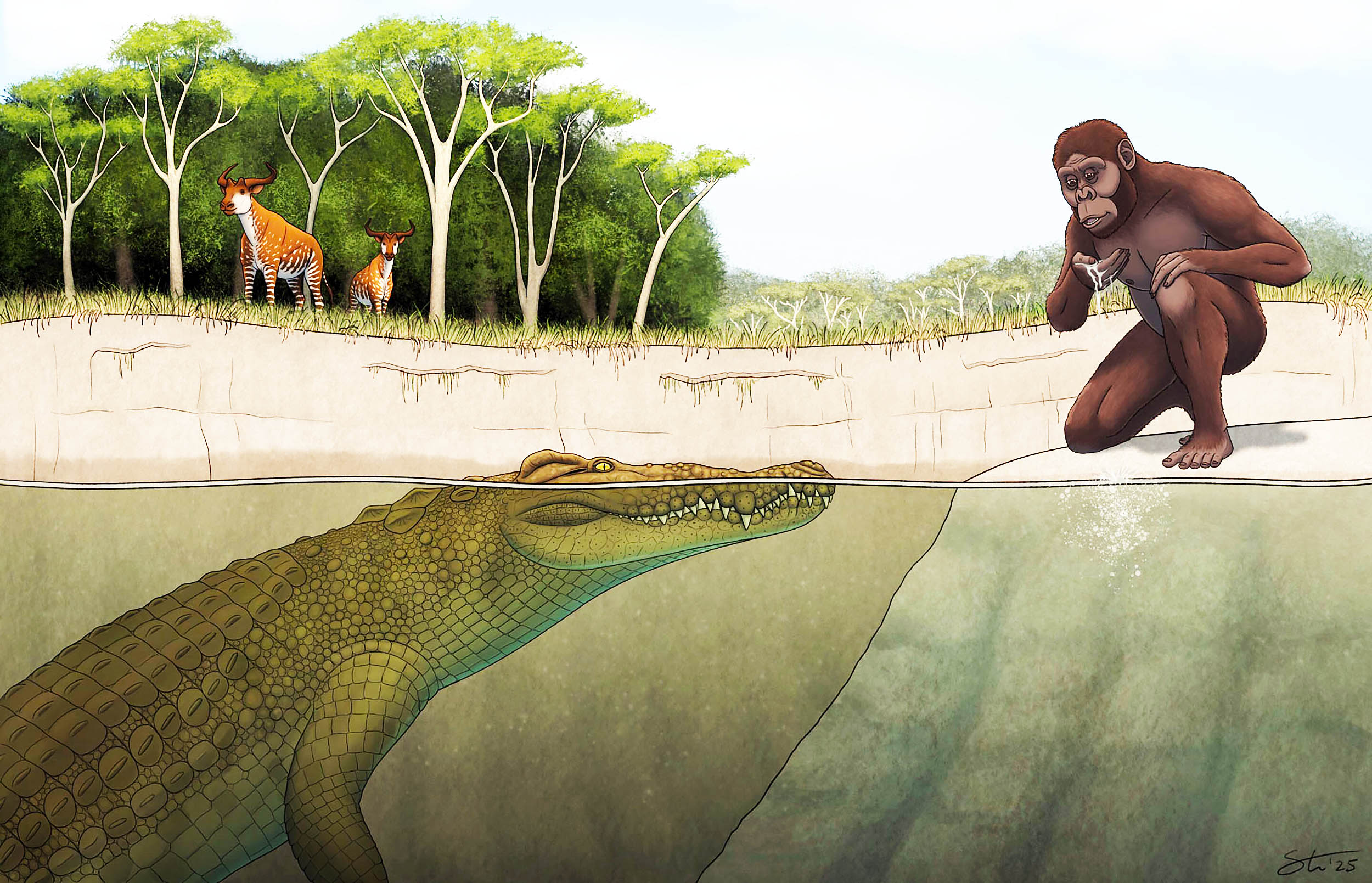
When we think about the dangers faced by our earliest ancestors, we often picture massive predators like saber-toothed cats or aggressive hyenas. But a fascinating new discovery suggests that one of the most formidable threats came from an unexpected source: a massive prehistoric crocodile that roamed African waterways over three million years ago.
Researchers have been studying the remains of Euthecodon, an ancient crocodile species that lived during the time of Lucy and other early human relatives. What makes this creature particularly intriguing is evidence suggesting it may have actively hunted hominins—our evolutionary ancestors—rather than simply scavenging opportunistically.
## A Different Kind of Predator
Unlike modern crocodiles that are primarily ambush predators waiting for prey to come to the water's edge, Euthecodon appears to have been a more active hunter. The size of this ancient reptile was impressive, making it a formidable threat to early humans who ventured near water sources. In an era before advanced weapons or sophisticated hunting strategies, our ancestors would have been vulnerable prey.
Water sources were critical to survival in ancient Africa. Early humans needed to drink, and the lands surrounding rivers and lakes often provided abundant food resources. This created a dangerous paradox: the places humans needed to visit most were exactly where these massive crocodiles patrolled.
## Evidence of Ancient Hunting Behavior
The research examining Euthecodon's remains has revealed intriguing clues about its diet and hunting patterns. Scientists have found evidence suggesting that this species may have specifically targeted hominins as part of their diet. This represents a significant finding, as it reshapes our understanding of the predator-prey relationships during this crucial period of human evolution.
The implications are striking. If early humans were indeed hunted by these crocodiles, it would have significantly impacted their behavior and survival strategies. Our ancestors may have developed increased wariness around water sources, traveled in larger groups for protection, or sought alternative water locations to avoid these dangerous predators.
## Shaping Human Evolution
Predation pressure has always played a crucial role in shaping evolution. The threat posed by Euthecodon could have influenced natural selection, favoring individuals with better instincts for danger, improved group cooperation, and enhanced problem-solving abilities. Over generations, these pressures may have contributed to the development of larger brains and more complex social structures.
Understanding these ancient predator-prey relationships helps us appreciate just how challenging life was for our ancestors. They weren't simply wandering peaceful landscapes—they were navigating a world filled with genuine threats, constantly adapting and evolving to survive.
The story of Lucy's hunter reminds us that human evolution wasn't a simple march of progress. Instead, it was a complex dance with our environment and the other creatures we shared it with, including a prehistoric crocodile that may have been far more interested in us than we ever realized.
No comments yet. Be the first!