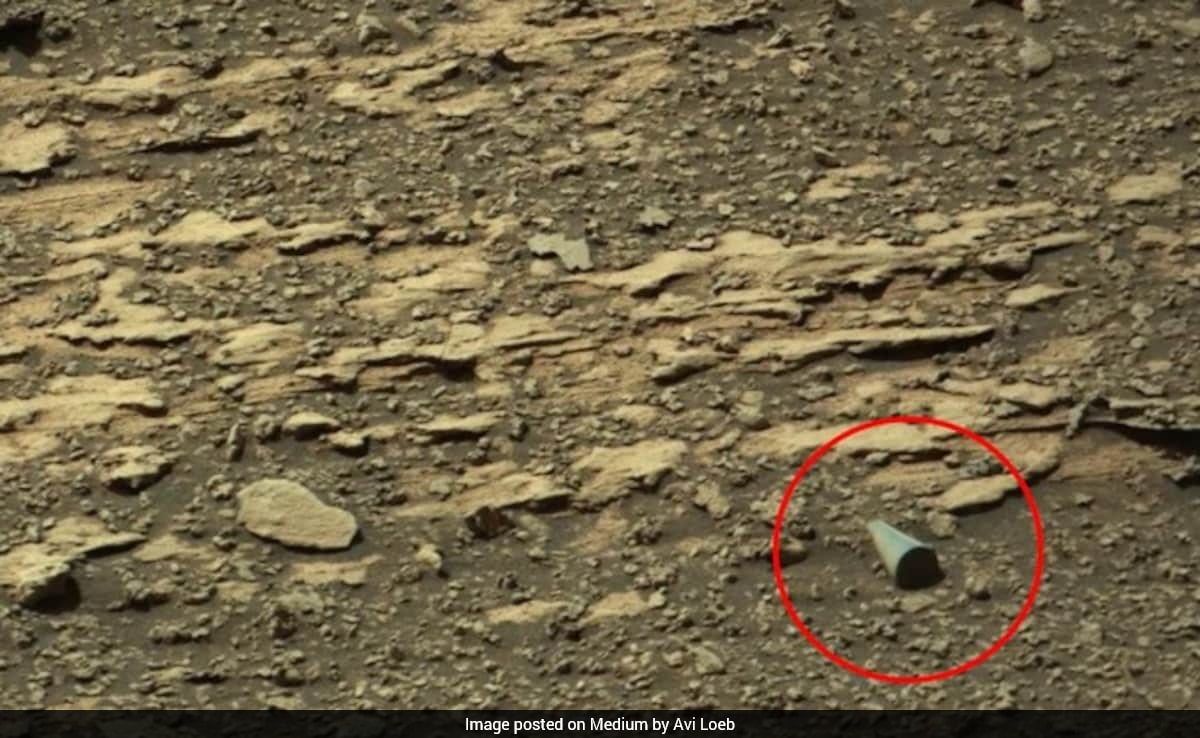
When NASA's Curiosity Rover captured images of an unusual cone-shaped object on the Martian surface, it set off alarm bells in the scientific community. The mysterious glinting object – roughly 20 centimetres long and gleaming against the rusty Red Planet landscape – has become the subject of heated discussion among researchers worldwide.
Harvard astronomer Avi Loeb, known for his willingness to explore unconventional explanations for cosmic mysteries, has publicly called on NASA to take a closer look at what many observers are dubbing the "party hat." Its distinctive geometric shape and reflective properties have captured imaginations, with some suggesting it could indicate something genuinely unusual about Mars.
But here's where the scientific plot thickens: not everyone is convinced we're looking at anything groundbreaking. Some of Loeb's colleagues propose far simpler, more conventional explanations. The object could be a piece of debris from the Curiosity Rover itself – perhaps a discarded component or equipment piece that's been sitting on the Martian surface for years. Alternatively, it might be a naturally occurring geological formation, possibly a mineral crystal or a rock shaped by Mars' harsh environmental conditions.
The cone's shiny appearance, which initially sparked excitement among observers, could be explained by the way light reflects off crystalline structures or smooth rock surfaces. On a planet with a thin atmosphere and bright sunlight, such reflections can appear far more striking than they would on Earth.
This discovery highlights a fascinating tension in modern astronomy: the balance between healthy skepticism and genuine scientific curiosity. On one hand, we should be rigorous in our investigation and not jump to extraordinary conclusions without extraordinary evidence. On the other hand, dismissing unusual observations without proper examination could cause us to overlook genuinely important discoveries.
Loeb's request for NASA to investigate represents the scientific method working as intended. Rather than accepting the object at face value or dismissing it outright, he's advocating for closer examination and data collection. NASA's rovers, equipped with sophisticated instruments, are perfectly positioned to gather the detailed analysis needed to definitively explain the object's composition and origin.
Whether this turns out to be an impressive piece of Martian geology, rover debris, or something more unexpected, the process of investigation itself is valuable. Each mystery solved on Mars brings us closer to understanding our neighboring planet's geology, history, and potential for past or present life.
For now, the mysterious cone remains a captivating reminder that Mars still holds surprises – and that sometimes, the most productive response to an unusual discovery is simply to look closer.
No comments yet. Be the first!