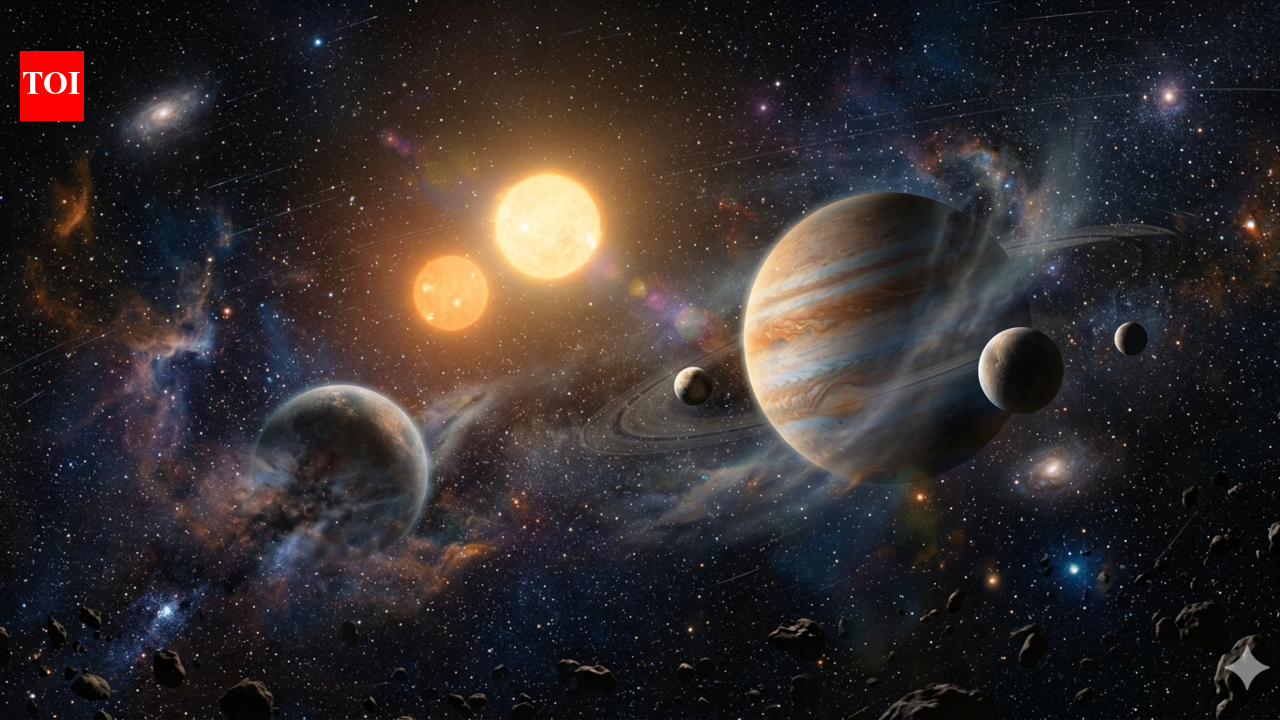
Remember those iconic scenes from Star Wars featuring Tatooine's twin sunsets? While planets orbiting two suns do exist in reality, astronomers are facing a puzzling problem: these circumbinary planets seem to be vanishing at an alarming rate.
For decades, scientists have theorized about worlds orbiting binary star systems—two stars locked in gravitational dance. The concept fascinated researchers and science fiction fans alike. Then, in 2011, astronomers confirmed the first real circumbinary planet, Kepler-16b, orbiting its twin stars. Since then, several others have been discovered, yet the numbers remain surprisingly low compared to theoretical predictions.
Now researchers believe Einstein's theory of general relativity might explain this cosmic disappearing act. Here's how it works: in binary star systems, the stars emit gravitational waves—ripples in spacetime itself. These waves carry away energy from the system, causing the orbits of both stars to gradually decay and spiral inward. For planets orbiting these binary pairs, this process creates an increasingly hostile environment.
As the stars creep closer together, their gravitational influence on any orbiting planet intensifies dramatically. The tidal forces become so extreme that planets get pulled apart or ejected from the system entirely. It's like being caught between two cosmic vacuum cleaners that are slowly moving toward each other, with no escape route available.
This gravitational wave phenomenon, predicted by Einstein over a century ago, only became directly observable in 2015 when scientists detected the first gravitational wave event. The discovery opened new possibilities for understanding stellar dynamics and planetary survival.
The implications are profound. If gravitational wave radiation is indeed destroying circumbinary planets, it suggests these worlds may be far more temporary than previously thought. Planets that managed to form in such systems might only persist for millions or billions of years before meeting their doom.
This research doesn't just explain missing planets—it fundamentally challenges our assumptions about habitability in binary star systems. While these environments clearly can host planets, their turbulent nature may make them among the least hospitable homes in the galaxy.
No comments yet. Be the first!