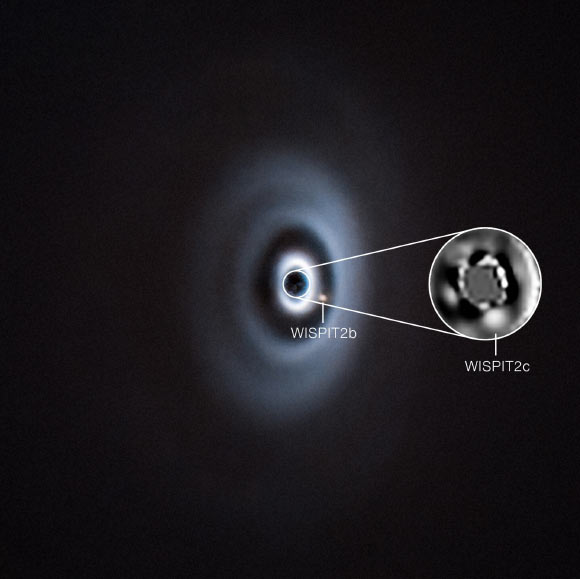
Imagine being able to watch a planet grow from scratch. That's essentially what astronomers just accomplished using ESO's Very Large Telescope (VLT) and VLT Interferometer (VLTI) in Chile. They've directly observed two gas giants emerging from the planet-forming disk surrounding a star called WISPIT 2, providing unprecedented insight into how planets like Jupiter actually form.
This discovery marks a significant milestone in planetary science. While we've spotted planets forming indirectly through various methods, direct observation of protoplanets—baby planets still embedded in their birth material—has remained frustratingly elusive. The two gas giants orbiting WISPIT 2 represent some of the clearest evidence yet that we can actually watch this cosmic construction process unfold.
What makes this observation so special? The VLTI's incredible resolution allows astronomers to detect the subtle signs of planetary formation that would otherwise remain hidden beneath vast clouds of dust and gas. By studying WISPIT 2, researchers can directly see how these massive worlds emerge and grow within their disk, shedding light on one of astronomy's most fundamental questions: how do planets form?
The star WISPIT 2 is young—still in the early stages of its life—which is exactly why it's so valuable for this research. Younger stars retain more of their planet-forming material, making them ideal laboratories for understanding planetary birth. The two protoplanets we can now observe are at a critical stage in their development, having grown large enough to become visible to our instruments while still embedded in the material from which they're forming.
This research carries profound implications for our understanding of planetary systems, including our own solar system. By observing how gas giants form around other stars, we gain crucial insights into how Jupiter and Saturn likely developed billions of years ago. We also learn more about the diversity of planetary systems in the universe—why some star systems have Jupiter-like planets close to their host star, while others have them farther out.
The ability to directly observe protoplanets also opens new doors for future research. As telescope technology continues to advance, astronomers will be able to study more systems in greater detail, mapping out the precise mechanisms of planet formation in real-time.
WISPIT 2 reminds us that the universe is far more dynamic than it might appear from a distance. Planets aren't ancient, static objects—they're born, grow, and evolve. And now, thanks to cutting-edge technology and patient observation, we're finally able to witness this cosmic drama as it unfolds. This breakthrough represents more than just a cool astronomical observation; it's a window into the very processes that created the worlds in our own cosmic backyard.
No comments yet. Be the first!