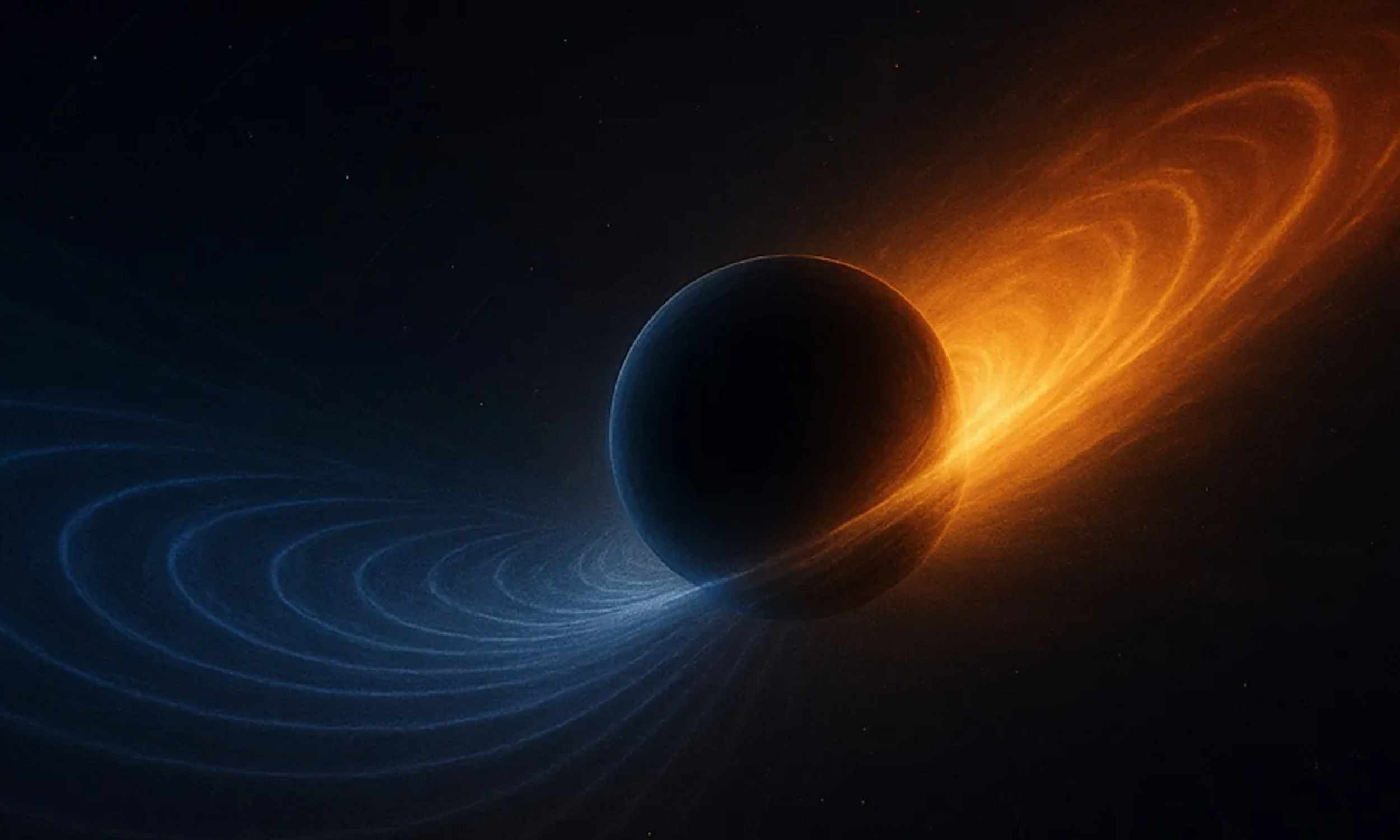
Imagine witnessing the birth of a cosmic monster—and then watching it sprint away at speeds that would make a spacecraft jealous. That's exactly what happened when scientists detected a newborn black hole escaping its origin at roughly 112,000 miles per hour (180,000 kilometers per hour). But here's what makes this discovery truly revolutionary: this is the first time researchers have been able to actually trace the black hole's escape route with precision.
So what caused this dramatic cosmic getaway? The black hole was born from a collision between two other black holes, which merged together to create this new gravitational beast. When these massive objects collided, they didn't create a simple, peaceful union. Instead, the violent merger generated ripples in spacetime itself—gravitational waves that scientists could detect and analyze.
These gravitational waves proved to be the key to unlocking this mystery. By studying the ripples traveling through the fabric of space and time, astronomers could not only confirm the black hole's existence but also map its trajectory as it fled from the collision site. It's like having a cosmic trail of breadcrumbs left behind by an escaping gravitational monster.
Why does a black hole run away after being born? The answer lies in the physics of the merger itself. When two black holes collide, their merger isn't perfectly symmetric. The gravitational waves are emitted in a way that creates an asymmetrical "kick"—essentially, the radiation pushes the newly formed black hole in one direction, propelling it away from its birthplace like a rocket with an invisible engine.
This discovery opens fascinating new windows into black hole behavior and the violent events that shape our universe. Previously, scientists had theoretical predictions about these gravitational kicks, but actually observing and tracing one in real-time is a game-changer. It confirms decades of mathematical models and provides concrete evidence of how black hole mergers work.
The technology that made this possible is equally impressive. Advanced gravitational wave detectors have become sensitive enough to not only detect these cosmic collisions but to extract detailed information about the objects involved. This represents a major leap forward in multi-messenger astronomy—the practice of observing cosmic events through multiple detection methods.
As our understanding of black holes deepens, we're realizing that these mysterious objects are far more dynamic and dramatic than we once thought. They don't simply sit quietly in space; they collide, merge, and escape in violent cosmic events that reshape the universe around them. Each discovery like this one helps us piece together the strange and wonderful physics that governs the most extreme environments in the cosmos.
The universe, it seems, is far stranger—and far more active—than we ever imagined.
No comments yet. Be the first!