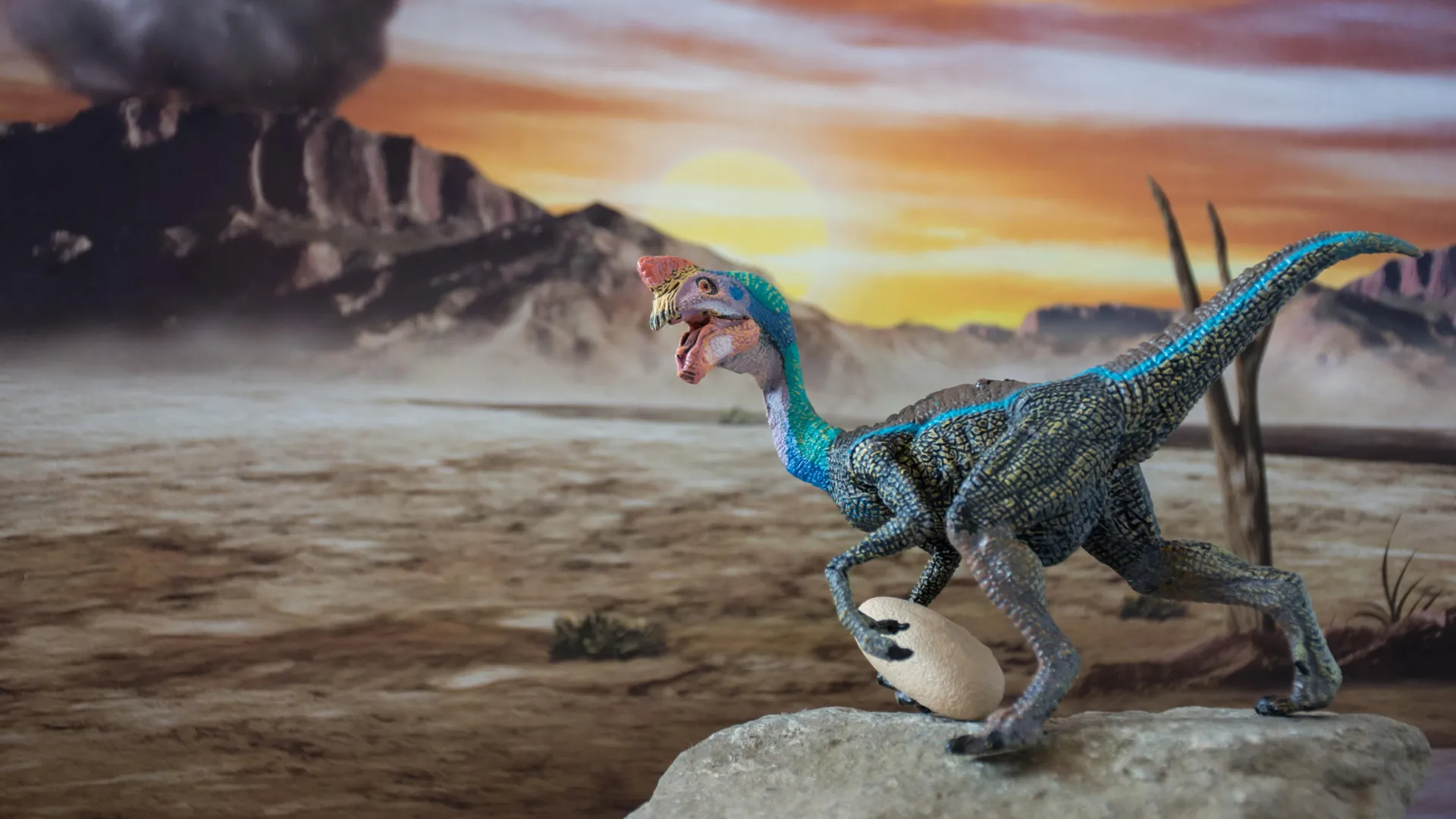
Imagine stepping back in time 70 million years to witness how dinosaurs cared for their eggs. While we can't actually time travel, a team of innovative researchers in Taiwan just did the next best thing: they built a life-size dinosaur nest to solve one of paleontology's most intriguing puzzles.
For decades, scientists have wondered exactly how dinosaurs incubated their eggs. Did they sit on them like modern birds? Did they use environmental heat from the ground or surrounding vegetation? The answer wasn't hiding in the fossil record—it required some creative detective work combining modern technology with old-fashioned experimentation.
**Building the Perfect Dinosaur Nest**
The Taiwanese research team didn't just theorize about ancient incubation methods. Instead, they constructed a full-scale model of a dinosaur nest and conducted physical experiments to test their hypotheses. But they didn't stop there—they also ran sophisticated heat transfer simulations to understand the thermal dynamics at play.
This dual approach allowed them to explore different incubation scenarios and see which ones were physically plausible. The simulations helped them calculate how heat would move through different nesting materials and structures, while the physical models provided real-world validation of their predictions.
**Learning from Modern Birds**
One of the most valuable aspects of this research was comparing their dinosaur findings with how modern birds incubate their eggs today. Birds are actually living descendants of theropod dinosaurs, making them perfect contemporary models for understanding ancient behavior.
By studying the similarities and differences between modern bird incubation and what the evidence suggests about dinosaur nesting, researchers gained crucial insights. This comparative approach helped them determine whether dinosaurs likely sat directly on their eggs, used external heat sources, or employed some combination of methods.
**What This Means for Paleontology**
This groundbreaking study represents a fascinating intersection of paleontology, physics, and biology. Rather than remaining stuck with incomplete fossil evidence, scientists are increasingly using experimental archaeology and computational modeling to breathe new life into ancient mysteries.
Understanding how dinosaurs incubated their eggs tells us much more than just parenting techniques. It reveals information about dinosaur metabolism, their environments, and how they adapted to their world. It also demonstrates remarkable parallels between ancient and modern life, showing how evolutionary strategies persist across millions of years.
**The Future of Fossil Interpretation**
This research opens doors for new methods of studying extinct species. When fossils alone can't provide complete answers, combining physical models with advanced simulations offers researchers powerful tools to reconstruct ancient behaviors and environments.
The next time you see a bird sitting patiently on her nest, you might just be witnessing a behavior that echoes back 70 million years to the age of dinosaurs. Thanks to these creative Taiwanese scientists, we're finally beginning to understand how our planet's most magnificent creatures raised the next generation.
No comments yet. Be the first!