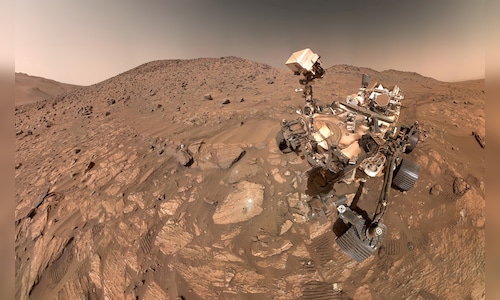
When we think of Mars today, we picture a barren, dusty landscape devoid of water and life. But billions of years ago, Mars may have looked radically different. NASA's Perseverance rover has just provided compelling new evidence of this dramatic transformation by discovering a buried ancient river delta dating back 3.7 billion years.
This remarkable find wasn't made through traditional surface exploration alone. Instead, scientists leveraged ground-penetrating radar technology—a tool that allows researchers to peer beneath Mars' surface without drilling—to detect the hidden structures of this long-lost river system. The discovery represents a significant leap forward in our understanding of Mars' geological history and the environmental conditions that may have once existed on the planet.
**Why This Matters for Finding Ancient Life**
River deltas are particularly significant in the search for evidence of past microbial life. These regions, where rivers once flowed into larger bodies of water, create ideal environments for microbial organisms to thrive and leave behind fossilized remains. The presence of this ancient delta suggests that Mars once had sustained water flow and stable environmental conditions—two critical ingredients necessary to support life as we understand it.
The discovery boosts scientific hopes that Perseverance and future rovers may eventually uncover biosignatures—physical or chemical evidence of ancient microbial life—in the Martian soil and rock samples. This isn't just about confirming that water once existed on Mars; it's about finding places where life might have actually flourished.
**The Technology Behind the Discovery**
Ground-penetrating radar is a non-invasive technology that sends radio waves into the ground and analyzes the returning signals to create detailed subsurface maps. This approach has proven invaluable for Mars exploration because it allows scientists to investigate geological structures without disturbing the landscape or requiring extensive drilling operations.
By using this technology, researchers can identify different layers of rock and sediment, revealing the ancient architecture of Mars' surface and the evidence of water systems that shaped the planet billions of years ago. It's a perfect example of how space exploration benefits from advances in technology.
**What's Next?**
This discovery opens new avenues for scientific investigation. Future missions to Mars may target similar buried river deltas, using them as prime locations to search for signs of ancient microbial life. The more we understand about where water once flowed on Mars, the better equipped we'll be to find evidence of the conditions that could have supported life.
The 3.7-billion-year-old river delta beneath Mars' surface is a testament to a time when the Red Planet was far more dynamic and habitable than it is today. As Perseverance continues its mission, discoveries like this remind us why the search for evidence of past Martian life remains one of the most compelling questions in modern space exploration.
No comments yet. Be the first!