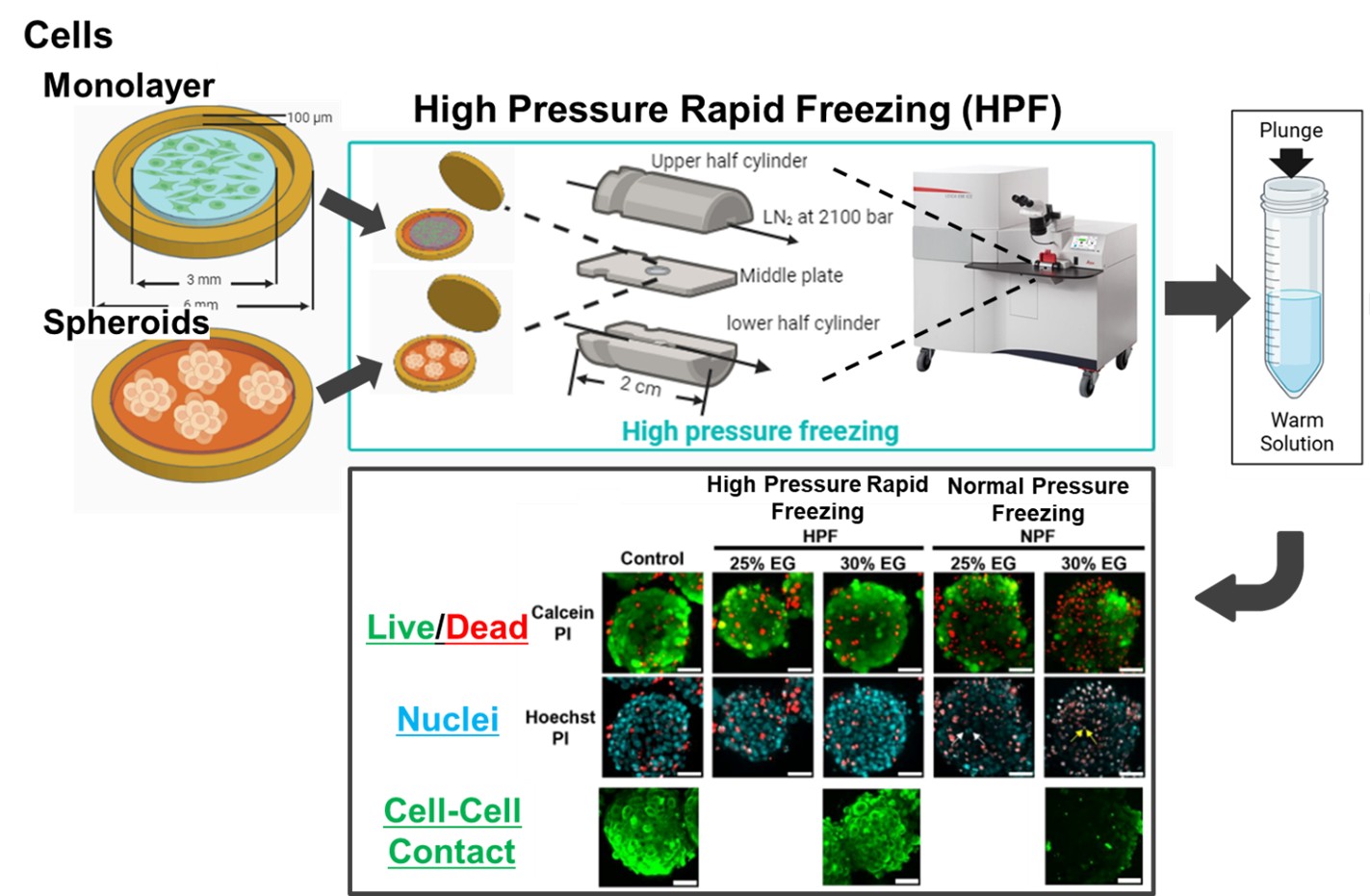
Imagine a future where damaged organs and tissues could be perfectly preserved and restored to their original state, ready to save lives years or even decades after they're frozen. While that might sound like science fiction, a recent breakthrough in cell cryopreservation is bringing us closer to making this vision a reality.
Researchers have successfully demonstrated the effectiveness of a high-pressure freezing method that instantaneously preserves cells—and it's the first empirical validation of its kind. This isn't just another incremental improvement in laboratory techniques; it represents a genuine leap forward in how we think about preserving biological materials.
**The Problem with Traditional Freezing**
For decades, scientists have struggled with a fundamental challenge: how to freeze cells without destroying them. Traditional cryopreservation methods, while useful, have significant limitations. When water inside cells freezes slowly, it forms ice crystals that can rupture cell membranes and damage delicate internal structures. Even when cells survive the freezing process, they often emerge weakened or non-functional—hardly ideal for medical applications.
**Enter High-Pressure Freezing**
The high-pressure method takes a radically different approach. By applying intense pressure and freezing cells instantaneously, researchers can bypass the formation of damaging ice crystals altogether. The rapid freezing process essentially captures cells in a state of suspended animation, preserving their structure and function in ways that traditional methods simply cannot achieve.
What makes this breakthrough particularly significant is that it's now been empirically validated. In science, validation matters enormously. Theoretical promise and practical results are two different things, and the fact that this method has been rigorously tested and proven effective opens doors that were previously closed.
**Why This Matters for Regenerative Medicine**
Regenerative medicine represents one of the most promising frontiers in modern healthcare. Researchers are working to develop treatments using stem cells, tissue engineering, and cellular therapies to repair or replace damaged organs and tissues. However, all of these applications depend on having access to healthy, viable cells that can be preserved and transported reliably.
This high-pressure freezing technique could be a game-changer. If cells can be frozen and preserved without losing their viability or function, it dramatically expands what's possible. Researchers could store cellular materials indefinitely, transport them globally, and have them ready for use whenever and wherever they're needed.
**Looking Ahead**
While this first successful validation is exciting, scientists emphasize that further development is needed before we see widespread applications. The method shows tremendous promise, but turning promising laboratory breakthroughs into practical medical treatments always requires additional research, refinement, and rigorous testing.
Still, the validation of this high-pressure freezing approach represents a meaningful step forward. It suggests that the barriers to effective cell preservation may be more surmountable than previously thought, and that regenerative medicine applications could advance more quickly than anticipated.
For patients waiting for new treatments and therapies, this breakthrough offers genuine hope that the future of medicine might be frozen—and that could be an incredibly good thing.
No comments yet. Be the first!