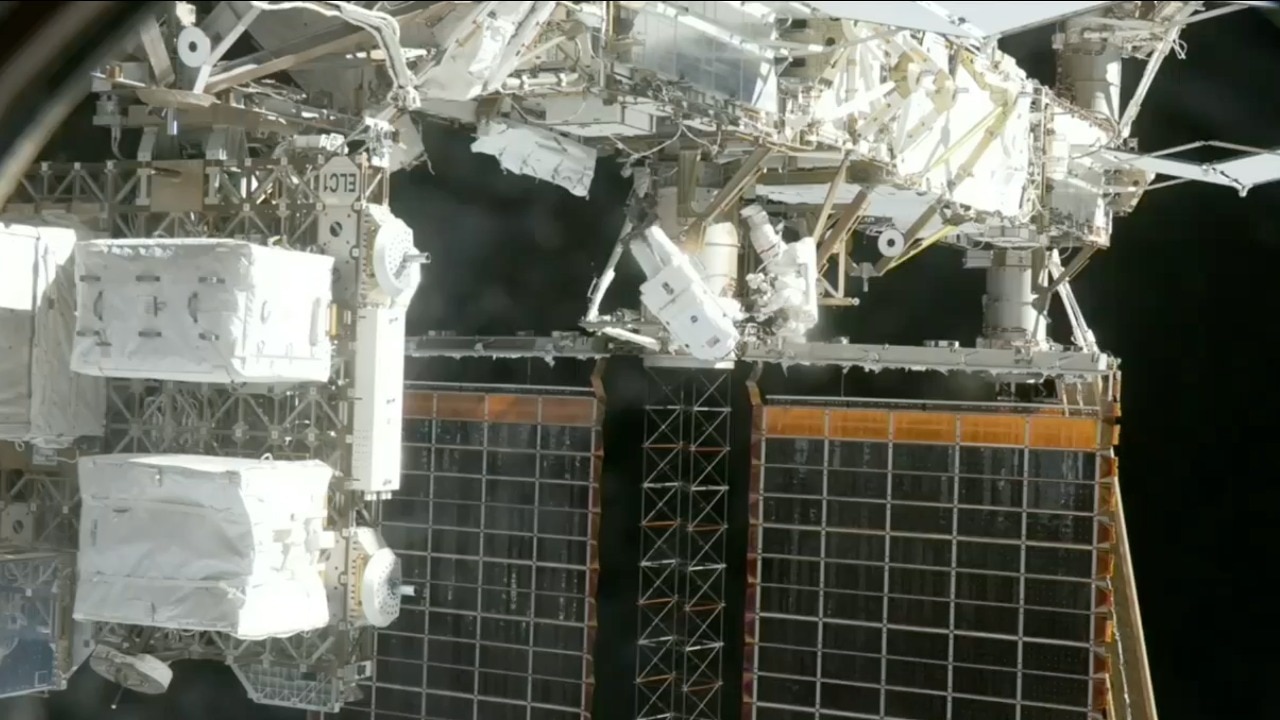
When you think about the most dangerous jobs on Earth, you might imagine deep-sea divers or mountain climbers. But nothing quite compares to the courage it takes to step outside a spacecraft and float 250 miles above our planet with only a spacesuit standing between you and the void of space.
That's exactly what NASA astronauts Jessica Meir and Chris Cassidy did recently, completing a major spacewalk outside the International Space Station (ISS) that lasted just over seven hours. Their mission? To execute critical upgrades and maintenance work on humanity's orbiting laboratory—work that's essential for keeping the ISS functioning at peak performance.
**A Delicate Dance in Zero Gravity**
Spacewalk missions are carefully choreographed operations that require meticulous planning and preparation. Every movement, every tool, and every procedure has been rehearsed dozens of times before astronauts ever leave the safety of the station. The stakes couldn't be higher—any equipment malfunction or miscalculation could have catastrophic consequences for the astronauts working in the harsh environment of space.
Meir and Cassidy's seven-hour mission wasn't just a routine maintenance check. The upgrades they completed are fundamental to the ISS's continued operation and its role as a cutting-edge research facility. These kinds of spacewalks represent the pinnacle of human spaceflight, combining technical expertise, physical endurance, and nerves of steel.
**Why Spacewalks Matter**
For those unfamiliar with the ISS, it's a collaborative effort between space agencies around the world, including NASA, Roscosmos (Russia), ESA (Europe), JAXA (Japan), and CSA (Canada). It serves as a laboratory where astronauts conduct experiments in microgravity that simply cannot be performed on Earth. From studying the effects of long-duration spaceflight on the human body to developing new materials and medicines, the research conducted aboard the ISS has far-reaching implications for science and technology.
But maintaining this orbital laboratory requires regular upkeep. Over time, equipment degrades, solar panels need adjustment, and systems require upgrades to keep pace with technological advances. That's where spacewalks come in. Astronauts must venture outside to handle tasks that robots and remote systems simply can't accomplish.
**The Human Element**
What makes missions like Meir and Cassidy's so remarkable is the human element. Despite decades of spaceflight experience and advanced technology, there's still something awe-inspiring about watching human beings operate in an environment so hostile to life. Their ability to focus, problem-solve, and execute complex tasks while floating in space is a testament to the rigorous training astronauts undergo and the incredible resilience of the human spirit.
As we look toward the future of space exploration—with plans for lunar bases and eventual missions to Mars—spacewalks like this one remind us of what humans are capable of achieving. These missions aren't just about maintaining a space station; they're about pushing the boundaries of human capability and advancing our understanding of space itself.
No comments yet. Be the first!