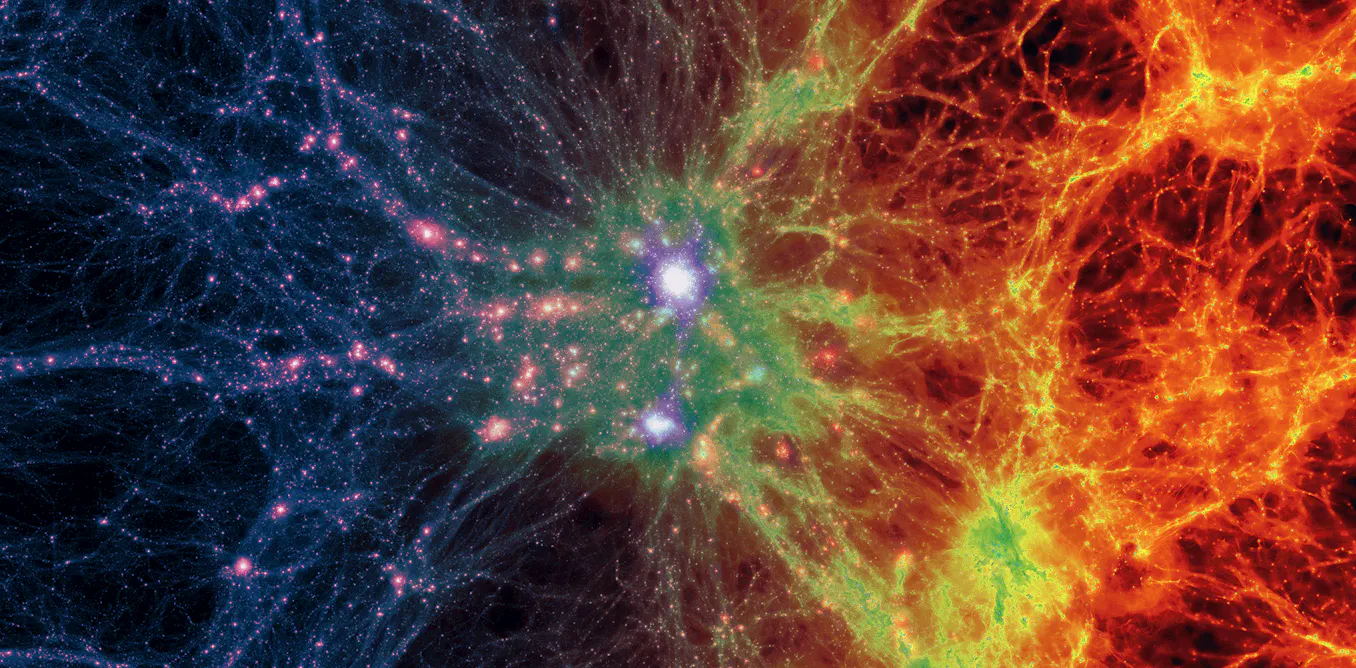
Dark matter has been cosmology's greatest headache for decades. We know it's out there because galaxies spin too fast to hold together with the amount of visible matter we can see, yet we have no idea what it actually is. Now, researchers are proposing a solution that sounds like science fiction: ancient black holes from a previous universe.
These aren't your garden-variety black holes formed from dying stars. Instead, scientists are theorizing about primordial black holes—relics created in the extreme conditions before the Big Bang itself. Imagine black holes so old they predate everything we can see, yet somehow survived and now permeate the cosmos as invisible scaffolding holding galaxies together.
The appeal of this hypothesis lies in its elegance. Rather than inventing entirely new particles or forces (like the leading "WIMP" and axion theories), this explanation uses something we already know exists: black holes. It's a bit like finding your missing keys were in your pocket all along.
But here's where it gets tricky. If dark matter were actually black holes, we should detect them through gravitational lensing and other observational methods. Recent research has placed constraints on this idea, suggesting primordial black holes alone probably can't account for all dark matter. However, they might contribute to a portion of it, working alongside other dark matter candidates.
What makes this research so captivating is the philosophical implication: our universe might be partially shaped by remnants of something that came before. It challenges our understanding of time, causality, and what came before the Big Bang itself—questions that keep cosmologists awake at night.
While we're nowhere near proving this theory, the fact that serious scientists are exploring the possibility shows how open the field has become. The truth is, dark matter remains stubbornly mysterious, and we may need to embrace increasingly creative explanations. Whether the answer involves black holes, yet-undiscovered particles, or something we haven't imagined, one thing is certain: the universe still has plenty of secrets to reveal.
No comments yet. Be the first!