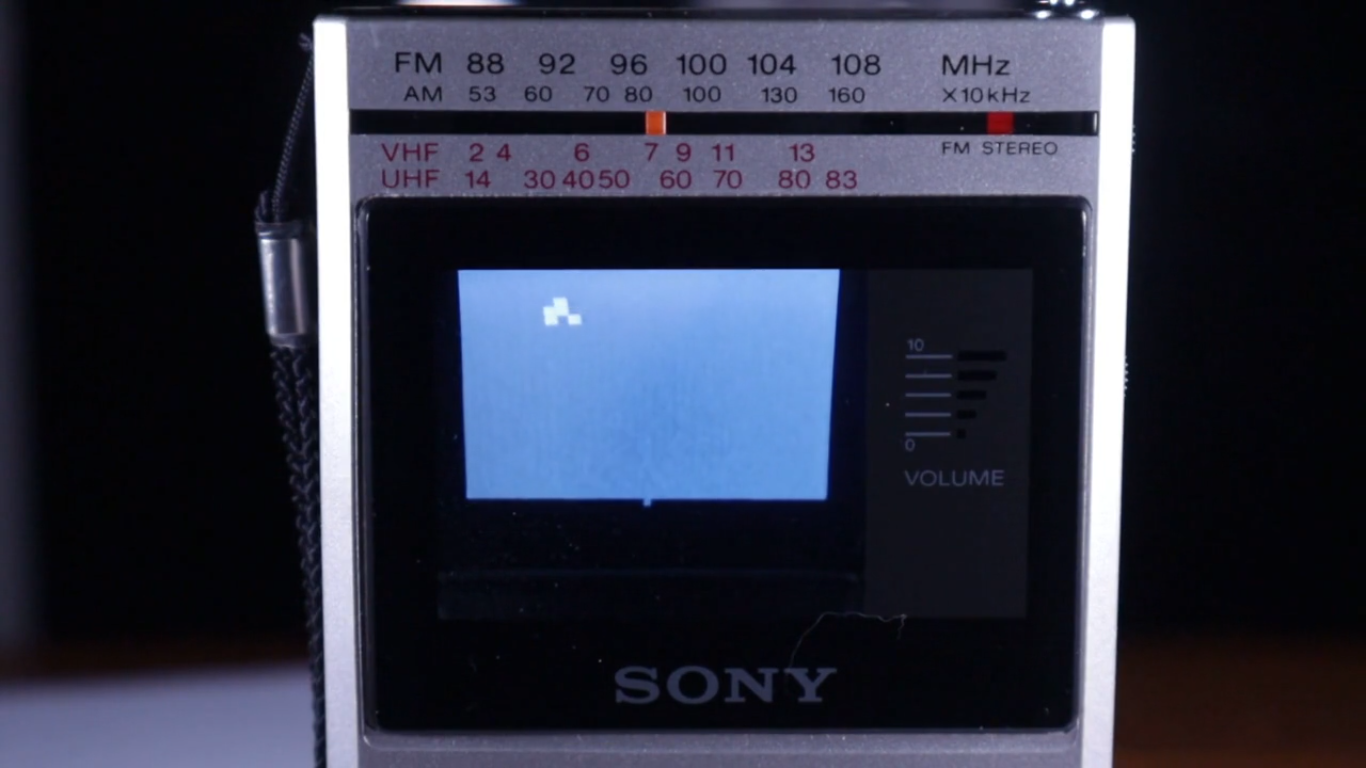
Remember CRTs? Those bulky cathode ray tube monitors that dominated computer labs and living rooms for decades? While they've largely vanished from our everyday lives, they represent a uniquely elegant technology: a purely analog display system designed for an analog world. Today's digital everything wasn't always the norm, and understanding how to interface with these vintage displays reveals some surprisingly clever engineering.
The challenge of generating analog video from an 8-bit microcontroller is deceptively simple on the surface but remarkably complex in execution. Modern microcontrollers are digital creatures at heart, operating in discrete 1s and 0s. CRTs, however, demand continuous analog signals—both for synchronization timing and for the actual video signal that controls beam intensity. This fundamental mismatch is exactly what makes this project so interesting.
The key to solving this puzzle lies in understanding CRT timing requirements. A CRT needs precise horizontal and vertical synchronization pulses to sweep the electron beam across the screen in the correct pattern. These aren't just simple on-off signals; they require specific pulse widths and timing intervals that vary depending on the display standard (NTSC, PAL, or VGA). An 8-bit microcontroller has just enough processing power to generate these signals with careful code optimization, toggling pins at precisely the right moments to create the necessary timing.
But timing is only half the battle. The actual video signal—the information that tells the CRT how bright the beam should be at any given moment—requires an analog voltage that can vary smoothly across a range. An 8-bit microcontroller doesn't have a built-in way to generate true analog voltages directly, so creative solutions are needed. Resistor ladders, PWM (pulse-width modulation) tricks, and careful filtering can convert the microcontroller's digital outputs into something resembling an analog signal smooth enough for a CRT to display.
What makes this project particularly elegant is that it demonstrates the fundamental principles of how digital and analog systems interact. It's a hands-on lesson in signal processing, timing constraints, and hardware-software co-design. Hobbyists and electronics enthusiasts have successfully generated recognizable video patterns on CRT displays using microcontrollers with less than a kilobyte of RAM—a testament to clever programming and deep understanding of the hardware.
This project sits at the intersection of nostalgia and education. While few people need to generate CRT video in their daily work anymore, the techniques involved are valuable for understanding legacy systems and appreciate how far display technology has come. It's also simply fun to make old technology work in new ways, proving that with ingenuity and persistence, you can push humble hardware to do unexpected things.
Whether you're interested in retro computing, hardware hacking, or just want to understand how the displays of yesteryear actually worked, generating analog video from a microcontroller is a rewarding challenge that illuminates the boundary between digital and analog electronics.
No comments yet. Be the first!