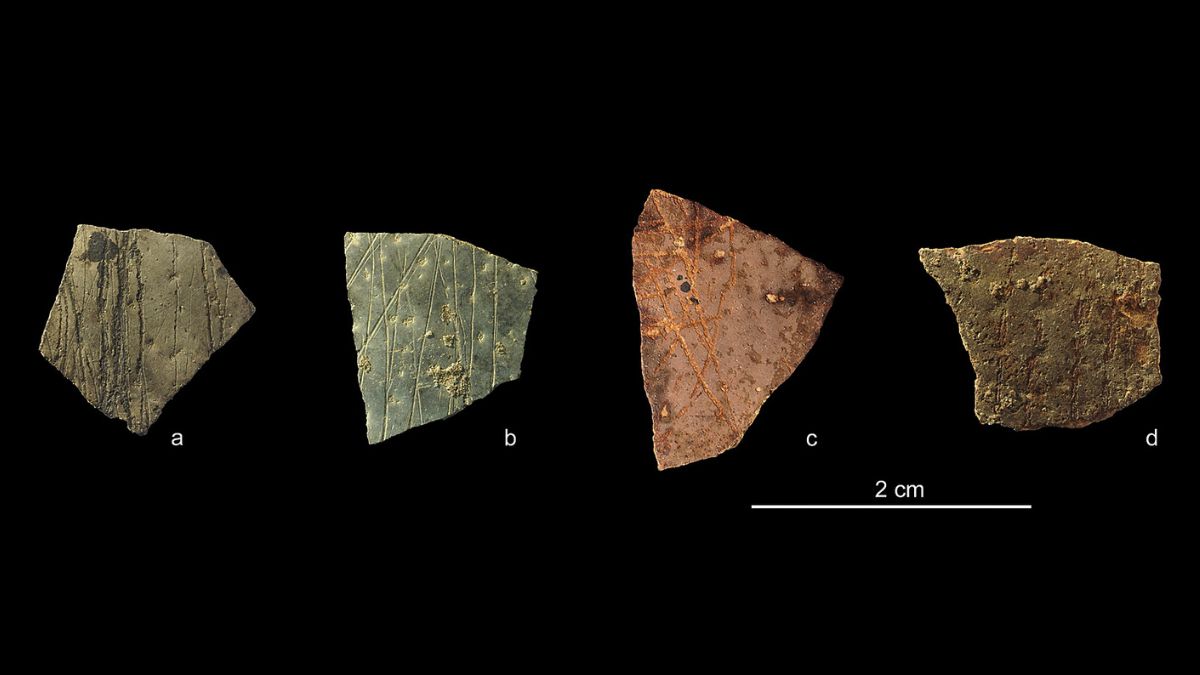
When we think of ancient humans, we often picture cave dwellers focused solely on survival—hunting, gathering, and avoiding predators. But new evidence from southern Africa is forcing us to completely reconsider that narrative. Researchers have discovered decorated ostrich eggshells that are approximately 60,000 years old, and they tell a remarkable story about human creativity, structure, and mathematical thinking.
These aren't crude scratches or random markings. The surviving fragments showcase intricate geometric patterns and engravings that reveal a sophisticated understanding of symmetry, proportion, and design. For our ancestors, decorated eggshells weren't just art—they were expressions of complex thinking that required planning, precision, and an appreciation for aesthetic beauty.
What makes this discovery particularly fascinating is its implications for understanding human cognitive development. Sixty thousand years ago, people hadn't yet invented writing systems, hadn't constructed monumental architecture, and hadn't developed the formal mathematical frameworks we associate with advanced civilizations. Yet here we have evidence that they were thinking geometrically, creating structured patterns, and engaging in what we might call proto-mathematical reasoning.
The ostrich eggshells likely served multiple purposes in ancient southern African communities. Beyond their decorative and aesthetic value, these shells were practical containers that could store water or food—precious resources in harsh environments. By adorning them with geometric patterns, ancient peoples transformed utilitarian objects into something more: symbols of identity, status, or spiritual significance.
Archaeologists have recovered these fragments across multiple sites in southern Africa, suggesting that this practice wasn't isolated or accidental. Instead, it appears to have been a widespread cultural practice, indicating shared knowledge and perhaps even artistic traditions passed down through generations. This points to complex social structures and communication among prehistoric communities.
The precision of the engravings is striking. Creating these patterns would have required steady hands, patience, and careful planning. Whether crafted with stone tools or bone implements, each geometric design demonstrates an intentional vision brought to life through skilled execution. This level of detail suggests that geometric thinking wasn't a byproduct of other activities—it was valued and cultivated.
These discoveries fundamentally challenge the notion that human progress is a linear journey from primitive to advanced thinking. Our ancestors possessed remarkable creative and intellectual capabilities far earlier than previously documented. They weren't simply reacting to their environment; they were actively imposing order, structure, and meaning onto it through artistic expression.
The ostrich eggshells remind us that the human capacity for abstract thought, geometric reasoning, and artistic expression is ancient. As we examine these fragile artifacts, we're essentially looking into the minds of people who lived 60,000 years ago—and what we see is intelligence, creativity, and a distinctly human desire to beautify the world around them. In many ways, these geometric patterns represent humanity's earliest known love affair with mathematics and design.
No comments yet. Be the first!